
Wardrobe Door Finishes Compared: Gloss, Matt, Laminate, Veneer and Acrylic for Gulf Homes
A wardrobe door finish is the visible surface layer — lacquer, laminate, wood veneer, acrylic or a super-matt coating — bonded over the board that forms each front. It decides how the doors look on day one, and how they respond to sunlight, fingerprints and cleaning for years afterwards. In UAE and Omani homes those three stresses are unusually strong, so the finish deserves as much thought as the layout.
ClosetWorld builds fitted wardrobes across the UAE and Oman, and every one of them needs this decision made. This guide compares the main options using manufacturers' and standards bodies' own data, so you can shortlist before you see samples.
Updated for 2026.
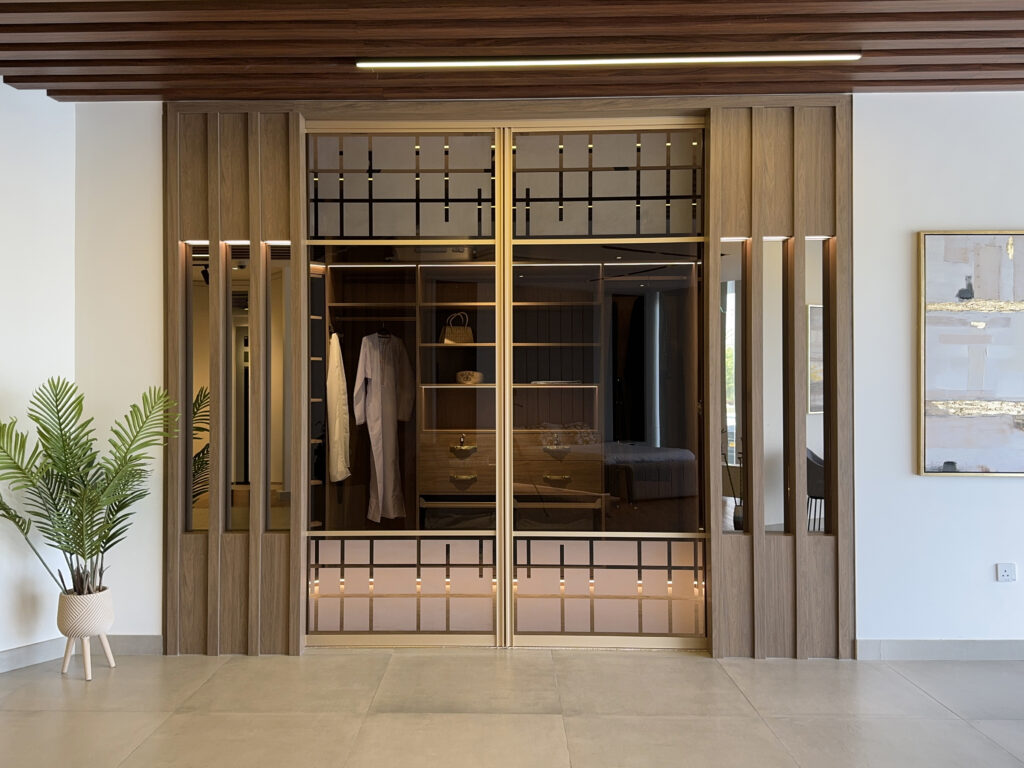
Why the surface takes a harder beating in the Gulf
Three conditions work on a wardrobe front here that a European showroom never tests for.
Sun through glass. UV levels in the UAE's summer reach the top band of the UV Index — "extreme", which the International Commission on Non-Ionizing Radiation Protection defines as 11 and above. A wardrobe facing a balcony door or a villa window gets that light every afternoon, and some surfaces change colour under it.
Humid air, then dry air. The UAE's National Center of Meteorology reported mean maximum relative humidity between 64% and 81% in July, and Muscat's humidity peaks in August. Inside, air-conditioning pulls that moisture down, so fronts cycle between damp and dry air. Our humidity-resistant closet guide covers the board and hardware side of that problem; the finish is the outer seal.
Dust and constant handling. The same NCM summary notes northwesterly winds that "sometimes cause blowing and suspended dust". Wardrobe doors are wiped far more often than most furniture, so a surface that marks under cleaning ages fastest of all.
The main finishes in brief
Before comparing them, it helps to know what each one physically is.
- Lacquer (gloss or matt). A sprayed coating, built up in layers over MDF and cured to a gloss level of your choice. Its behaviour depends heavily on the resin chemistry used.
- Melamine-faced board. Decorative paper soaked in melamine resin, pressed straight onto MDF or particleboard. Laminex describes this "low-pressure melamine" as paper bonded to both sides of a rigid core.
- High-pressure laminate (HPL). Layers of resin-impregnated paper pressed at 120 °C or more and 5 MPa or more, according to ICDLI, the European laminate makers' body. It forms a separate sheet that is then glued to a board.
- Wood veneer. A thin slice of real timber over a stable core — normally 0.5 to 0.85 mm thick in the Australian and New Zealand market, according to the Timber Veneer Association of Australia.
- Acrylic. A high-gloss polymer sheet laminated to board. REHAU's technical guide describes its RAUVISIO brilliant range as a co-extruded laminate with an acrylate top layer, rated at a gloss of 85 or more.
- Super-matt and nano-technology surfaces. Very low-sheen coatings or films sold on anti-fingerprint behaviour — examples include EGGER PerfectSense Matt, FENIX NTM and RENOLIT's polyester-based matt films.
Schedule your complimentary design session — talk these surfaces through with a designer before you commit. Book a consultation or call 800 29029.
Seven questions that narrow the choice
Work through these in order. By the fourth or fifth, most homes are down to two finishes.
Question 1: How much direct sun reaches the doors?
This is the question that rules finishes out. The Timber Veneer Association of Australia says UV exposure usually causes "a gradual bleaching of red/dark woods and a yellowing of blonde woods", and recommends coatings with UV blockers. A veneered wardrobe opposite a west-facing window is likely to drift from the colour of its sample.
Lacquer depends on its chemistry. Coatings maker Covestro notes that polyurethane lacquers based on TDI or MDI isocyanates "have a tendency to yellow when exposed to light", while HDI- and IPDI-based systems are light-stable. So "white lacquer" is not one product — ask which system is specified.
Printed surfaces are designed for this. ICDLI states that an HPL print "is more lightfast than natural veneer or wood", and REHAU rates its acrylic at level 7 on the blue wool lightfastness scale. Both are manufacturers' own data, but both are measured claims rather than adjectives.
Question 2: How many hands touch the doors every day?
A children's room, a family hallway or a shared master wardrobe gets handled constantly. Manufacturers market super-matt ranges specifically on anti-fingerprint behaviour — EGGER describes its matt surface as having "a special look, feel and anti-fingerprint feature". That tells you where fingerprints are a known complaint.
For heavily used rooms, a textured or super-matt front is usually the practical choice. Our children's wardrobe designs are the clearest example of where this matters.
Question 3: How will they be cleaned, and by whom?
This is where finishes differ most, and the makers' care sheets contradict each other:
- EGGER PerfectSense: no microfibre cloths or cleaning erasers, "since these often contain fine abrasive particles", and no steam cleaners.
- REHAU acrylic: clean with a damp microfibre cloth and mild soap, and never dry-wipe.
- FENIX NTM: a wet melamine eraser is allowed for tougher stains, but abrasive cream can leave "a glossy spot on your matt surface".
- HPL (ICDLI): water, then dry with a paper tissue or soft cloth.
The lesson is to follow the care sheet for the exact product on your doors, not a rule for the finish type. If a housekeeper cleans the wardrobes, hand them that sheet.
Question 4: How much reflection do you want in the room?
Gloss is measurable. The HPL trade body pro-HPL gives extremely matt surfaces a gloss level of about 2 to 5, and smooth glossy surfaces about 80 or more (at a 60° measurement). FENIX quotes 8 to 16 for its matt surface at 85°.
High gloss bounces light around a small bedroom and makes a run of doors read as one plane. In a dressing room already full of feature lighting, it can also double every LED strip. If reflection is the goal, compare gloss with mirror-fronted wardrobes and glass door wardrobes for display before deciding.
Speak with our design experts. Bring a photo of the room at the brightest time of day, and a designer will talk through how gloss and matt surfaces will behave in that light. Talk to a designer.
Question 5: What happens when a door gets marked?
Every surface eventually picks up a scratch. What differs is the repair. REHAU says surface marks on its acrylic can be removed "by manual or machine grinding and polishing". FENIX states that "thermal healing of superficial micro-scratches is also possible" on NTM — a manufacturer's claim, but a specific one.
Printed melamine and HPL are different: a scratch deep enough to cut the decor paper removes the pattern itself, so polishing cannot restore it. For those, the realistic repair is a new front. On a wardrobe ClosetWorld built, that is exactly what our door replacement service for existing ClosetWorld units provides.
Question 6: Will the panels see heat before they reach your home?
This one is easy to miss in a Gulf summer. REHAU's guide says its acrylic boards should never be exposed to temperatures above 60 °C during transport, and should be stored away from strong UV. In a Gulf summer, that makes storage and delivery part of the specification. Ask how panels are kept and moved, especially for high-gloss fronts.
Question 7: Does the finish suit the board and the door mechanism?
The finish is only as good as what sits beneath and around it. The substrate choice is covered in our comparison of MDF, plywood and solid-wood carcasses, including why edge banding matters as much as the board.
Door movement matters too. A tall sliding door and a hinged door handle wear differently at the edges, so check our sliding versus hinged door guide alongside this one.
Wardrobe door finishes side by side
This table summarises the sourced points above. It is a shortlist tool, not a ranking — the right answer depends on your room.
| Finish | Look | In direct sun | Sold as anti-fingerprint? | Cleaning (per maker) | Worth knowing |
|---|---|---|---|---|---|
| Gloss lacquer | Deep, seamless shine | Depends on resin: TDI/MDI can yellow, HDI/IPDI light-stable | No | Follow the coating supplier's sheet | Ask which lacquer system is used |
| Matt lacquer | Soft, painted look | As gloss lacquer | Some super-matt lacquers are | Follow the supplier's sheet | Can be colour-matched to walls |
| Melamine-faced board | Printed wood, stone or solid colour | Printed decor | Some matt ranges are | Follow the board maker's sheet | Paper bonded directly to board |
| HPL | Printed decor | ICDLI: more lightfast than veneer | Some matt ranges are | Water, then dry with a soft cloth | Pressed at ≥120 °C, ≥5 MPa |
| Wood veneer | Real timber grain | Dark woods bleach, pale woods yellow | No | Follow the coating's sheet | UV-blocking topcoat recommended |
| Acrylic | Mirror-like high gloss (≥85) | Lightfastness level 7 (REHAU) | No | Damp microfibre and mild soap, never dry | Keep below 60 °C in transit |
| Super-matt / nano-tech | Velvety, very low sheen | Varies by product | Yes | Varies: check erasers and cloths | Care rules conflict between brands |
Matching a finish to the room
Putting the seven questions together, a few patterns come up again and again.
A sea-facing bedroom in Muscat or Dubai. Strong afternoon sun and coastal humidity point towards a printed surface or a light-stable lacquer rather than natural veneer on the sunlit wall. Our master bedroom closet guide for Omani villas and climate-adapted wardrobes for Oman cover the rest of that brief.
A windowless walk-in closet. With no sunlight, veneer's colour change stops being a concern, and real timber comes back onto the list. See walk-in closet builds across Dubai and walk-in closets for Muscat homes for layouts.
A dressing room built to impress. High-gloss acrylic or gloss lacquer suits a luxury dressing room in Dubai, provided cleaning rules are agreed from the start.
A busy family hallway or shared wardrobe. Super-matt or textured fronts forgive handling, and a reach-in closet in a practical finish often outlasts a showpiece.
If you want to see a finish on your own elevations first, our 3D design service lets you see the design on your own walls before anything is made.
Door Finish FAQ
Which wardrobe door finish is best for a sunny room in Dubai?
Will a white lacquered wardrobe turn yellow?
What is the difference between melamine board and HPL?
How do I clean super-matt anti-fingerprint wardrobe doors?
Does high-gloss acrylic scratch, and can it be repaired?
How reflective is a gloss wardrobe compared with a matt one?
Can I change the finish on my existing ClosetWorld wardrobe later?
Related Reading at ClosetWorld
- MDF, plywood or solid wood: the board behind the finish — substrate choices for UAE and Oman climates
- How sliding and hinged doors wear differently — the mechanism that carries your chosen finish
- Mirror wardrobes for Dubai interiors — when reflection matters more than colour
- Moisture-proof construction in Dubai — protecting what sits behind the surface
- Custom closet costs in Oman — how door and finish choices move a budget
- Our materials and components — hinges, tracks and shelving behind every front
Claim your free design consultation. A ClosetWorld designer will shortlist finishes for your rooms, your light and your cleaning routine. Book your consultation or call 800 29029.
Guide by the ClosetWorld design team. Updated September 2026. Sources: UAE National Center of Meteorology July climate summary (via Aletihad); Foreca / Copernicus C3S Muscat climate averages; ICNIRP UV Index; ICDLI and pro-HPL technical leaflets; Laminex; Timber Veneer Association of Australia; Covestro; REHAU RAUVISIO brilliant technical guide (03.2025); EGGER PerfectSense care leaflet; FENIX NTM; RENOLIT.