
Custom Closet Cost in Oman: What Drives Your OMR Investment (2026)
The cost of a custom closet in Oman is driven less by a per-metre sticker price than by five variables: the carcass material, the door system, the internal fittings, the linear run of the wardrobe, and site conditions in the villa or apartment. In Muscat’s market — where imported European hardware and coastal-fog-rated materials sit alongside locally sourced board — those variables move a project’s budget far more than floor area alone. This guide is a budgeting framework, not a price list: it explains what each cost driver does to your OMR investment, gives broad illustrative ranges, and shows where spending returns value at resale. ClosetWorld has delivered 145+ villa projects across Muscat, Sohar, and Salalah since entering Oman, and every quotation is scoped after a free design consultation.
Updated for 2026. Every OMR figure below is an illustrative planning range, not a quote. Because two wardrobes of identical width can differ by several hundred rials once you change the board grade or add lit pull-outs, a custom closet cannot be honestly priced from a table — only scoped after measurement. Use these ranges to understand why a budget moves and where your money works hardest, then let a consultation turn the framework into an exact figure. This is the approach ClosetWorld has refined across our full product range over 14 years.
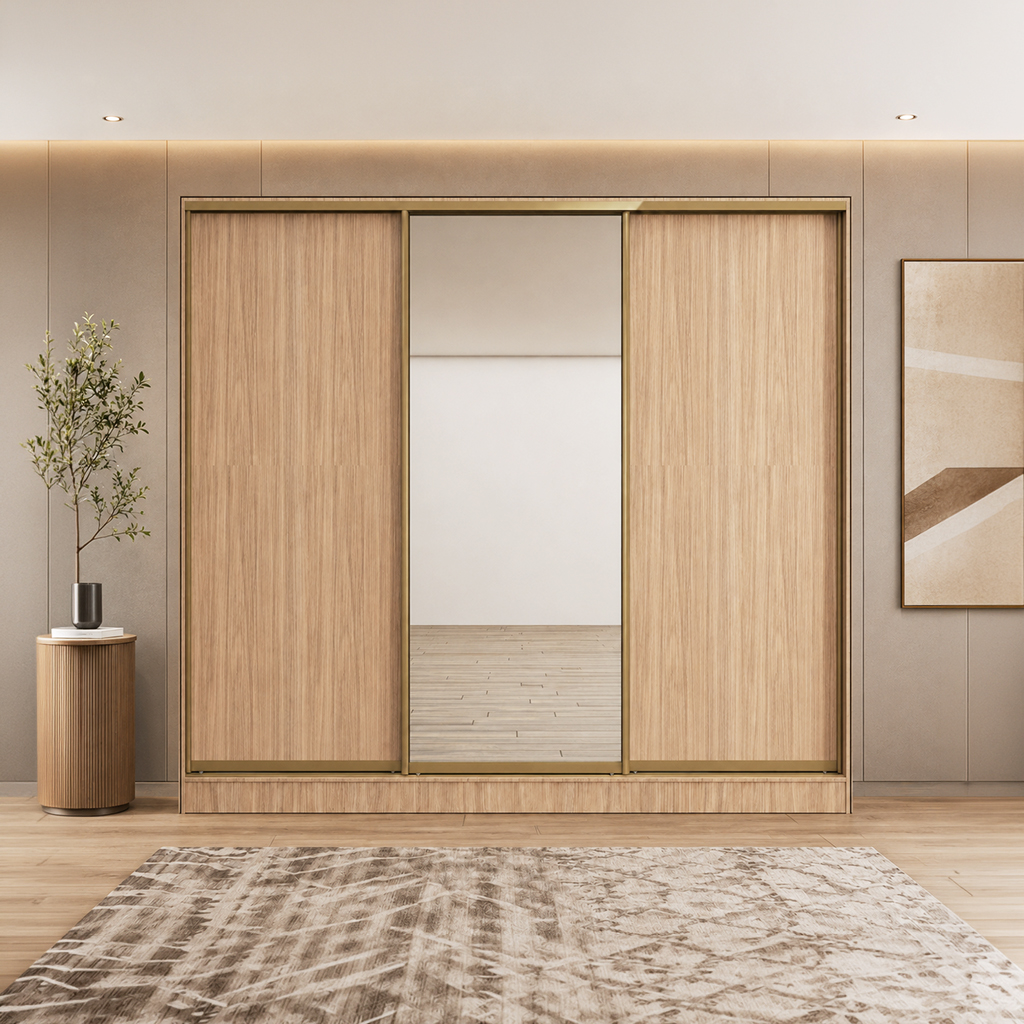
The Five Cost Drivers of a Custom Closet
Ask "what does a custom wardrobe cost in Muscat?" and the honest answer is "it depends on five things, in this order of impact." Floor area is not on the list, it only matters insofar as it determines how many linear metres of cabinetry you install. The five drivers below account for almost the entire spread between a modest reach-in and a luxury walk-in, and understanding them lets you steer the budget deliberately rather than being surprised by a quotation.
Here is the whole framework at a glance. Each row is a lever you can pull up or down:
| Cost driver | Lower-budget choice | Premium choice | Effect on OMR budget | Effect on lifespan / value |
|---|---|---|---|---|
| Carcass material | Locally sourced moisture-resistant MDF / melamine board | Grade-A moisture-rated board or BWP-plywood carcass | Roughly +OMR 40–120 per linear metre stepping up | Coastal-fog resistance and a 15-year warranty vs early swelling in humid rooms |
| Door system | Hinged doors on standard hinges | Sliding doors on European soft-close tracks; mirror or glass fronts | Roughly +OMR 60–200 per linear metre for sliding + glass | Quieter daily use, no swing wear, higher perceived value at viewing |
| Internal fittings | Fixed shelves + a single hanging rail | Pull-out trays, lit drawers, jewellery inserts, adjustable modules | Adds OMR 100–800+ depending on module count | Turns capacity into usability, the detail buyers notice |
| Linear run / layout | Single-wall reach-in on a 2.5–4 m wall | Full-perimeter walk-in or his-and-hers run | Each added linear metre multiplies the base cost | More storage per room; defines the reach-in vs walk-in tier |
| Site works | Square walls, standard 2.6 m ceiling, ground-floor access | Out-of-square villa walls, 3.0 m+ ceilings, coastal upgrades | Scribing, filler panels and upgrades add to labour | Correct fit prevents gaps, dust traps and rework |
The sections that follow take each driver in turn. Read them as dials: turn material and doors up on the wardrobe you use every day, keep them modest in a guest room, and let the linear run follow the space you genuinely need rather than the space you happen to have.
Carcass Material and How It Moves the Budget
The carcass — the box structure of shelves, sides and back panels — is where material choice quietly decides both your budget and how long the wardrobe survives Muscat’s climate. It is the largest single material component, so a step up in board grade multiplies across every linear metre. The choice runs from standard moisture-resistant MDF and melamine-faced board, through Grade-A moisture-rated board, to boiling-water-proof (BWP) plywood carcasses for the most demanding wet or coastal conditions.
In Oman’s coastal belt, this is not only an aesthetic decision. Salt-laden coastal fog and AC condensation attack the edges and back panels of ordinary board first, causing the swelling and delamination that shortens a wardrobe’s life. Specifying a moisture-rated carcass with sealed edges is the difference between a unit that still looks square in year ten and one that needs replacing. ClosetWorld builds to a Grade-A board standard backed by a 15-year warranty, and treats coastal-rated material as the default for Muscat rather than an upsell.
For the full technical trade-off between board types — how each behaves under humidity and load, and where the cost premium is justified — see the MDF, plywood and solid-wood material comparison and the specification detail on our premium materials. The short version for budgeting: material is the first lever to protect, not the first to cut, especially near the coast.
Door Systems and Hardware
After the carcass, the door system is the most visible cost lever and the one clients most often underestimate. Hinged doors are the simpler, lower-cost option: standard hinges, a straightforward carcass, and no track to house. Sliding doors carry a hardware premium because the track, rollers and anti-derailment mechanism are engineering components in their own right — but they consume zero swing space, which is why they suit narrow Muscat apartment bedrooms and corridors.
Three sub-choices then move the figure further. Soft-close mechanisms add a modest per-door cost but transform daily use and reduce long-term wear. Mirror and glass fronts are a significant premium over solid panels, adding both material and careful handling to the build. And hardware finish matters functionally in a coastal home: corrosion-resistant runners and tracks resist the pitting that humid, salt-laden air causes on cheaper metal.
For budgeting, treat doors as the second lever to weigh against how you live: sliding, soft-close, mirror-fronted doors on the wardrobe you open every morning; simpler hinged fronts where a guest room only needs occasional access. The door system also shapes the internal layout, because a sliding wardrobe only exposes half its width at a time — a point covered further in the wardrobe design process in Muscat.
Internal Fittings and Accessories
Fittings are where cost compounds fastest, because each one is an added module rather than a one-time structural choice. A bare carcass with fixed shelves and a single rail is inexpensive; the same box filled with pull-out trays, soft-close drawers, trouser racks, lit shelving, valet rods and lined jewellery inserts can add several hundred rials — and it is precisely this layer that turns raw capacity into a wardrobe you actually enjoy using.
The temptation is to specify every accessory at once. A more disciplined approach is to fit the modules you will use daily and leave the carcass adjustable so more can be added later. Integrated LED lighting is a common early upgrade — it improves usability and presents beautifully — while niche items like watch winders or deep jewellery trays can wait unless they solve a real storage problem you have today.
Two accessory decisions carry outsized value. First, drawers over open shelves for anything you fold, because they protect contents from coastal dust. Second, lit, ventilated compartments in humid rooms. Both cost more up front and both pay back in daily use and longevity. For a sense of how fittings scale with room size and how much a given run can actually hold, our closet sizing guide sets out the dimensional logic behind each module.
Size, Linear Metres and Layout
This is the driver most people get wrong, because they assume a bigger room automatically means a bigger bill. In custom cabinetry, cost follows the linear metres of wardrobe you install, not the empty floor area of the room. A large bedroom fitted with a single 3-metre wardrobe wall can cost less than a compact room fitted out on three walls. The per-linear-metre concept is the planning unit professionals use: it lets you compare a budget board run against a premium one on a like-for-like basis before layout, height and fittings adjust the figure.
Layout then sets the tier. A reach-in closet — a single-wall fitted wardrobe, typically 60 cm deep on a 2.5–4 m wall — is the entry level of custom cabinetry in Oman. Stepping up to a walk-in adds storage on two or three walls, often an island, and a dressing zone, which multiplies the linear run and therefore the budget. That step from reach-in to walk-in is usually the single largest jump in a project’s cost, so it deserves a deliberate decision rather than a default.
Ceiling height is the quiet multiplier within layout. Muscat villas frequently offer 3.0–3.4 m ceilings, and running cabinetry to full height adds linear area and often a mezzanine tier — more storage, but more material and labour. When you are ready to translate a run length into a real configuration, Muscat walk-in closet projects and our walk-in closet configurations show how the metres resolve into usable storage.
Site Conditions in Omani Homes
The final driver is the one clients cannot see on a mood board: the condition of the space itself. Omani villas are often generously proportioned but rarely perfectly square, and a custom wardrobe has to be scribed to fit walls that lean, floors that fall away, and corners that aren’t quite 90 degrees. This scribing, plus filler panels and packing, is genuine labour — and it is the reason a truly fitted wardrobe costs more than a freestanding unit pushed against a wall, while also being the reason it looks seamless.
Three site factors move the figure most in Oman. High villa ceilings add height-related material and access work. Apartment access — lifts, stair turns, protected corridors — affects delivery and installation labour. And coastal location triggers the material upgrades discussed above: in Muscat’s humid, salt-touched air, moisture-rated board and corrosion-resistant hardware are specification decisions, not luxuries. The engineering behind that is set out in humidity-resistant wardrobe engineering for Oman.
None of this should be a surprise line on a final invoice. A proper survey identifies out-of-square walls, AC ducts, electrical conduit and plumbing chases before a price is issued — which is exactly why the figures below are ranges until your room is measured.
Book your free consultation today and let our team survey the actual space before you commit to a number. Call 800 29029, visit our Muscat showroom at 33B Al Mawaleh Square, Al Seeb, or book your free consultation online — there is no charge and no obligation.
Budgeting by Project Type (Illustrative OMR Ranges)
With the five drivers in mind, here are broad planning ranges by project type. These are illustrative statistics only — a way to place your project on a scale — not quotations. Every figure moves with the material, doors, fittings and site conditions above, and every real project is scoped in writing after a free consultation.
Reach-in / single-wall fitted wardrobe (2.5–4 m wall, 60 cm deep): roughly OMR 400–1,400. The entry tier of custom cabinetry — a fitted upgrade over freestanding furniture for an apartment or secondary bedroom.
Full built-in bedroom wardrobe run (master or guest, wall-to-wall): roughly OMR 1,200–3,500. More linear metres, often full-height, with a richer fittings package. This is the sweet spot for a fitted full-bedroom scheme.
Walk-in closet (single-user to his-and-hers): roughly OMR 3,000–8,000. Storage on two or three walls, an island or seating, and a dressing zone — the step up in linear run drives the step up in budget.
Luxury dressing room / island walk-in (full perimeter, premium doors, integrated lighting): roughly OMR 8,000–18,000+. A room-scale fit-out where material grade, glass fronts and bespoke fittings all sit at the top of their range.
Read these bands against the drivers, not in isolation. A walk-in specified in standard board with hinged doors can land near the bottom of its range; a full-bedroom run in premium board with sliding glass fronts and a full fittings package can exceed it. The framework tells you which direction each choice pushes; the consultation tells you where you actually land.
Real Muscat Project: What the Budget Actually Bought
Client: The Al-Balushi family, a four-bedroom villa near Al Mawaleh Square, Al Seeb.
Challenge: The master bedroom had a 4.6 m wall of freestanding wardrobes that had swelled at the base after two humid summers, plus an adjoining 9 sqm room the family wanted converted into a shared his-and-hers walk-in. Coastal condensation had already damaged the existing units.
Solution: We specified a Grade-A moisture-rated carcass throughout, sliding mirror-fronted doors on the master wall to preserve floor space, and a walk-in with storage on three walls — 7.4 linear metres of run, a central drawer island, lit hanging sections at two heights, and lined trays for accessories. Corrosion-resistant tracks were used given the coastal exposure.
Result: Hanging capacity roughly doubled over the old freestanding setup, the swelling problem was designed out with sealed, moisture-rated board, and the whole fit-out was installed in three business days. The investment sat in the walk-in band above, weighted by the premium material and glass fronts — a figure confirmed in a scoped quotation before any manufacturing began.
“We were nervous about cost, but the team explained exactly what we were paying for and why the coastal-rated board mattered here. The quote never changed. The walk-in has completely changed how our mornings work.” — Aisha Al-Balushi, Al Seeb, Muscat
Where Spend Returns Value: ROI and Resale in Oman
Not every rial in a wardrobe returns the same value, and a good budget concentrates spend where it does. Three areas reliably repay the investment. First, carcass material and moisture rating — because a wardrobe that fails in year five has returned nothing, while one that stays square for fifteen years under a warranty keeps earning. Second, the fittings you use daily, which convert dead space into genuine capacity. Third, clean, fully fitted joinery, which is what buyers and valuers actually register when they view a home.
In Muscat’s villa market especially, built-in storage signals a finished, move-in-ready property. Freestanding furniture reads as temporary; seamless fitted wardrobes read as part of the home’s specification, supporting both the asking price and the speed of a sale. This is the value language rather than a price promise — but across 145+ Oman villa projects it is a consistent pattern, and it is why our villa wardrobe work in Oman leans toward permanent, high-finish fit-outs.
The corollary is where not to overspend. Niche accessories you will rarely use, top-tier finishes in a guest room, or full-height runs in a low-traffic space rarely return their cost. A disciplined budget, shaped by the five drivers, puts the money on the wardrobe you live in and keeps it modest elsewhere.
How ClosetWorld Scopes and Quotes Your Project
ClosetWorld’s pricing is deliberately transparent, because a custom closet is a considered purchase and hidden fees erode trust fast. The path from illustrative range to committed figure has three clear stages, and the first two are free.
It begins with understanding the space and the wardrobe it must hold. A design consultant — at your home or at our Al Mawaleh Square showroom — discusses your needs, then measures the room and records its real conditions: out-of-square walls, ceiling height, AC ducts, and coastal exposure. Nothing is estimated blind. From there, material, door and fittings recommendations are matched to how you actually live and to your budget, so the specification is honest rather than maximal.
Only then do you receive a written quotation scoped to your exact project — carcass, linear run, doors, fittings and any site works, itemised — before any manufacturing starts. That figure does not drift afterward. Grade-A board, the 15-year warranty and a typical 2–3 business-day installation are part of the offer, not extras. You can see the wider methodology on our design and installation process, and the company’s track record on the page about our team and history.
Schedule your complimentary design session to turn this framework into a firm number. Call 800 29029 or arrange your session online, and visit us at our Muscat showroom, 33B Al Mawaleh Square, Al Seeb.
Turn the Framework Into Your Figure
This guide gives you the drivers; a measured consultation gives you the number. Our Muscat design team will survey your villa or apartment, record its real conditions, and translate the framework above into a transparent, scoped quotation with no hidden fees — the OMR figure that fits your space, your specification and your budget. Get your personalized storage assessment with no obligation: call 800 29029, get in touch with our Muscat design team, or visit our showroom at 33B Al Mawaleh Square, Al Seeb, Muscat.
ClosetWorld — Decades of Excellence and Innovation 14+ years · 145+ villa projects across Muscat, Sohar, and Salalah · 800 29029 Written by Yusra Al-Habsi, Senior Design Consultant (14 years experience)
Frequently Asked Questions
What's the biggest factor in custom closet cost in Muscat?
Is a reach-in closet cheaper than a walk-in in Oman?
How is a wardrobe priced — per linear metre or per unit?
Do coastal-fog materials cost more in Muscat?
Does a bigger room always cost more?
What's included in the free design consultation?
Do you provide a fixed quote before work starts?
How does a custom closet affect resale value in Oman?
Related Reading at ClosetWorld
To take your budget from framework to specification: