
Closet Sizing Guide: How Much Space Do You Need for a Walk-In, Reach-In, or Dressing Room?
A walk-in closet needs a minimum of 4 square metres of floor area and 2.6 metres of ceiling height to function comfortably. A reach-in closet needs 1.5 metres of wall width and 60 centimetres of depth. A dressing room needs 8–15 square metres to integrate vanity, seating, and full-perimeter storage. This guide provides the exact dimensional requirements for each closet format, including the often-overlooked clearances — walkway widths, door swing radii, hanging-rod heights, and shelf-pull-out depths — that determine whether a closet works in practice or merely looks good on paper.
Why Sizing Decisions Are Critical Upstream
Closet size is decided at the wall-and-floor layout stage, not at the cabinetry stage. Once the room is built, a 3.2-metre wall can’t become a 4.0-metre wall. The dimensional thresholds below are the minimums — closets sized at minimum work but feel cramped; closets sized at 120% of minimum are comfortable; closets sized at 150% of minimum allow for upgrades like double-hanging, seating, or integrated vanities. We see 30+ closet projects each month across the UAE and Oman, and the most common regret expressed by clients is “I wish I’d made it 30 centimetres wider.”
Walk-In Closet Dimensions
Minimum Walk-In Footprint
A walk-in must accommodate:
- A 90 cm walkway down the centre (the minimum for a single person to turn around)
- 60 cm of storage depth on at least one wall (the minimum for a hanging rod with full clearance)
- A door clearance of 80 cm if the door swings inward, or 0 cm if the door slides
Absolute minimum walk-in: 2.4 m wide × 1.6 m deep = 3.84 sqm. This gives you 1.6 m of single-side storage. It’s tight but workable for one user with a curated wardrobe.
Comfortable single-user walk-in: 2.6 m × 2.4 m = 6.24 sqm. Storage on three walls (the back, plus 1.4 m on each side), 90 cm walkway, room for a low bench or shoe rack.
Two-user walk-in (his-and-hers): 3.0 m × 3.4 m = 10.2 sqm. Storage on three walls, 1.2 m central walkway, dedicated his/hers sections, room for seating and a vanity corner.
Luxury walk-in with vanity + seating + island: 4.0 m × 4.5 m = 18 sqm. Full perimeter storage, central island with drawer storage, seating, integrated mirror walls.
For Dubai-specific apartment-vs-villa walk-in planning, see our Dubai walk-in closets page. For Abu Dhabi villa walk-ins (which typically start at 8 sqm), see our Abu Dhabi walk-in wardrobes page.
Walk-In Ceiling Height
- Absolute minimum: 2.4 m (allows single-rod hanging at 2.0 m, with 40 cm above for shelving)
- Recommended minimum: 2.6 m (allows double-rod hanging — long-hang at 2.0 m, short-hang at 2.4 m, with finger-clearance above)
- Premium walk-in: 3.0 m+ (allows integrated lighting, crown moulding, full-height mirror walls)
UAE apartments typically have 2.6–2.8 m ceilings; Dubai villas have 3.0–3.2 m; Abu Dhabi villas 3.2–3.6 m; Oman villas 3.0–3.4 m. Sharjah older apartments may have 2.4 m ceilings — walkable but limits configuration options.
Walk-In Walkway and Clearance
The walkway in a walk-in is non-negotiable: 90 cm minimum, 1.0 m comfortable, 1.2 m for two users passing simultaneously. Below 90 cm, you cannot turn around while wearing a coat or carrying clothing. Walkways of 80 cm or less violate accessible-design standards and routinely fail post-install satisfaction.
If your walk-in has a hinged door, add the door’s 80 cm swing radius to the walkway requirement at the entry — i.e., the area immediately inside the door must be clear of storage projection.
Reach-In Closet Dimensions
Minimum Reach-In Footprint
A reach-in is defined by depth (you reach into it, you don’t enter it). Minimum dimensions:
- Width: 1.5 m (smaller widths produce single-shelf closets that aren’t worth the build cost)
- Depth: 60 cm (the absolute minimum for a hanging rod with clothing on a standard hanger)
- Height: 2.2 m (allows a single hanging rod at 1.7 m with a top shelf above)
Standard reach-in: 2.0–2.4 m wide × 60 cm deep × 2.6 m high. Typical Dubai apartment bedroom configuration.
Wide reach-in: 3.0–3.6 m wide × 60 cm deep × 2.6 m high. Common in master bedrooms where a built-in alternative is preferred over a walk-in. See our Dubai master bedroom wardrobes page.
Tall reach-in (with mezzanine storage): 1.8 m wide × 65 cm deep × 2.8–3.0 m high. The top 60 cm becomes seasonal storage; mezzanine doors open separately.
Reach-In Depth Variants
- 60 cm depth: Standard — works for hanging rods with most adult garments.
- 65 cm depth: Allows pull-out drawers with full-extension runners.
- 70 cm depth: Premium — accommodates wider hangers (suit hangers, garment-bag clearance) and deep-drawer organization for jewelry/accessories.
- 50 cm depth: Sub-minimum — only works for shelving (no hanging). Best suited for linen closets, not bedroom wardrobes.
Reach-In Door Clearance
A 70 cm hinged-door swing requires 70 cm of clear floor area in front of the closet. In bedrooms where the bed is positioned within 70 cm of the closet wall, hinged doors hit the mattress — specify sliding doors or bi-fold doors instead.
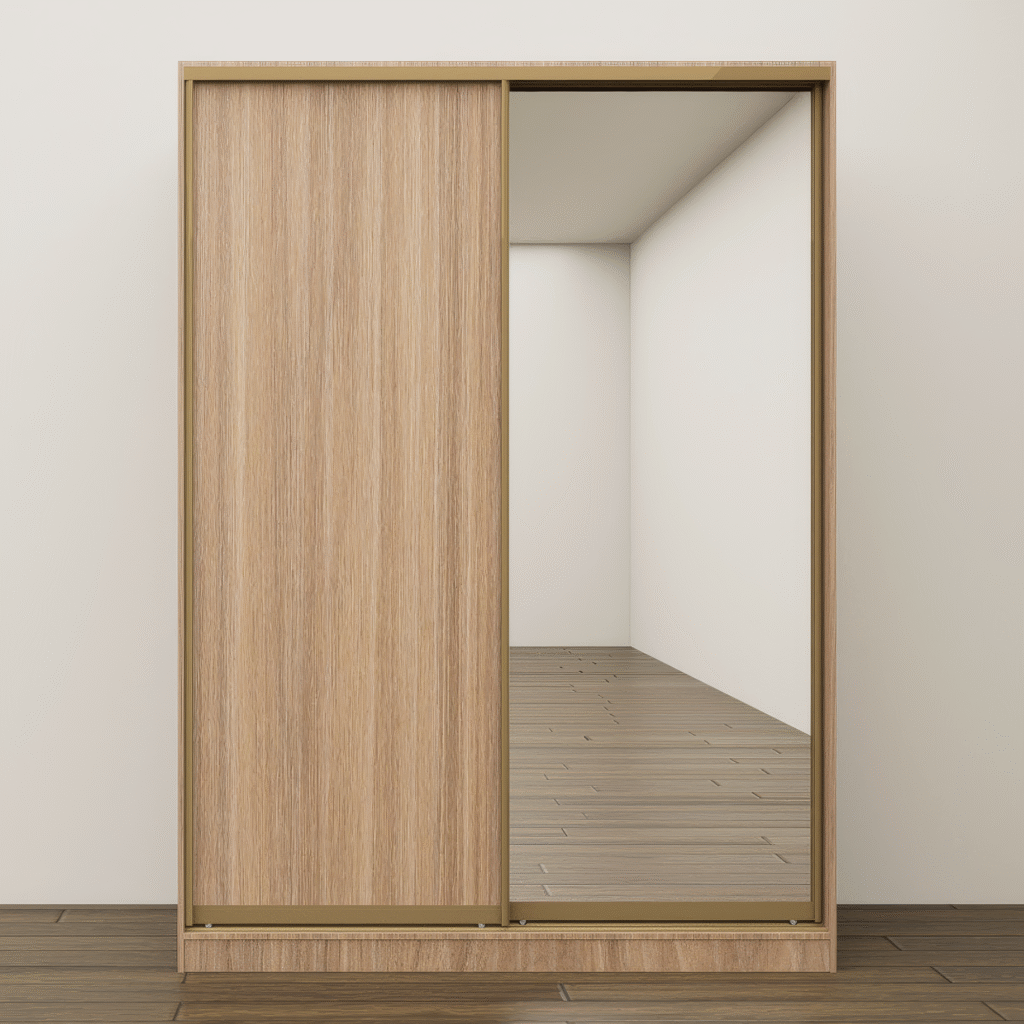
Reach-In With Sliding Doors
Sliding-door reach-ins have specific track geometry:
- 2-door sliding: Each panel is 50% of the width minus 5 cm overlap. A 2.4 m wide closet has 1.15 m panels.
- 3-door sliding: Each panel is 33% of width minus overlaps. Useful for 3.0 m+ wide closets.
- Bypass track depth: 8–10 cm (top track) plus 2–4 cm (bottom track or floor guide). Increases the closet’s required wall footprint slightly.
Specify Blum or Hettich sliding tracks with soft-close — see our soft-close wardrobe features page for hardware specification.
Dressing Room Dimensions
A dressing room is distinguished from a walk-in by its room-scale features: vanity, seating, full-length mirror, and natural light source. Minimum sizing:
- Compact dressing room: 3.0 m × 3.0 m = 9 sqm. Storage on two walls, vanity on a third, seating in the centre. Single user.
- Standard dressing room: 3.5 m × 4.0 m = 14 sqm. Storage on three walls, vanity + chair, full-length mirror wall, daylight from a window or skylight.
- Luxury dressing room: 4.5 m × 5.5 m = 25 sqm. Full perimeter storage with a central island, dedicated vanity station with chair and counter, sitting area with armchair, full-length mirror walls on two sides.
Dressing rooms benefit from natural light — design ideally includes a window or skylight providing daylight to the vanity area. Without natural light, daylight-spectrum LED lighting (4000-5000 K) at the vanity is essential. For full Dubai dressing-room planning, see our Dubai dressing room design page.
Hanging Rod Heights and Section Lengths
Single-Rod Heights
- Long-hang (dresses, coats, suits): 1.8 m above floor for the rod, allowing 1.6 m of garment length to clear the floor.
- Short-hang (shirts, jackets, folded trousers): 1.0 m above floor with a second rod at 2.0 m for vertical doubling.
- Above-cabinet seasonal hang: 2.4–2.6 m for tall hanging spaces accessed less frequently.
Section Length per Garment Type
A standard person’s wardrobe occupies the following horizontal hanging space:
| Garment type | Hangers per 30 cm | Notes |
|---|---|---|
| Shirts (folded on hangers) | 12–15 | Standard shirt hangers |
| Dresses | 8–10 | Mid-length dresses |
| Suits | 6–8 | With suit hangers, wider |
| Coats and outerwear | 4–6 | Padded hangers, bulkier |
| Trousers (folded over hanger) | 10–12 | Trouser bar hangers |
Plan minimum hanging length: 1.5–2.0 m for a single-user wardrobe, 3.0–4.0 m for a two-user wardrobe, 5.0–6.0 m for a luxury his-and-hers wardrobe.
Drawer and Shelf Depths
- Standard drawer: 60 cm depth, 10 cm height for jewelry/accessories; 15 cm for socks/underwear; 22 cm for folded shirts; 30 cm for sweaters.
- Shelf depth: 30–35 cm for folded clothes; 25 cm for shoes (standard adult); 35 cm for boots; 40 cm for handbags.
- Shoe storage capacity: 35 cm width per pair of standard adult shoes; 45 cm per pair of boots; account for seasonal rotation.
Climate and Material Sizing Implications
Humidity-resistant material specification has minor sizing impact: edge-banded panels are 1-2 mm thicker than melamine-only panels, and humidity-gasket doors require an additional 3-5 mm gap. These add up to ~10-15 mm of total closet width consumption. For tight-tolerance fits (e.g. exactly filling a wall niche), specify the material and gasket type before final measurement. Our humidity-resistant closets page covers material engineering.
Common Sizing Mistakes (and How to Avoid Them)
Mistake 1: Designing the Closet Before the Wardrobe Inventory
The most common sizing mistake is specifying closet dimensions before measuring what the closet will hold. Count your hangers (typical: 60–120 per single-user wardrobe), measure your longest garment, count drawer-worthy items (typical: 6–10 drawers needed), and quantify your shoes (typical: 20–60 pairs per single-user). Then size the closet to the wardrobe, not the other way around.
Mistake 2: Forgetting Door Swing
A 70 cm hinged door needs 70 cm of clear floor in front. In tight bedrooms, this floor is also where you’d stand to access the closet — so the door blocks access while open. Sliding or bi-fold doors are usually the better solution for tight bedrooms.
Mistake 3: Skimping on Ceiling Height
Specifying a 2.4 m ceiling closet to “save cost” eliminates double-hanging and forces you into single-rod-only configuration. The cost savings are typically AED 1,500–2,500; the storage loss is 40-50%. Always size to 2.6 m if structurally possible.
Mistake 4: Underestimating Walkway Width
90 cm walkway is the absolute minimum; 1.0 m is comfortable. Anything below 90 cm forces sideways shuffling and creates daily friction. We’ve never had a client complain that their walkway was too wide; we’ve had dozens regret that it was too narrow.
Mistake 5: Not Accounting for Trip Hazards
Bottom-track sliding doors create a 2-4 cm raised lip that becomes a trip hazard, especially in low-light morning routines. Either specify top-only suspended-track systems, or accept hinged/bi-fold doors. Recessed floor tracks (flush with the floor) cost more but eliminate the hazard.
Confirm Your Closet Dimensions with a ClosetWorld Site Visit
This guide gives you the framework; an in-home measurement gives you the build-ready dimensions. Request a free home visit from our design team — we’ll measure the space, identify wall constructions and obstacles (AC ducts, electrical conduit, plumbing chase), and confirm what your room can accommodate. Call 800 29029, contact us online, or book your free consultation today at any of our Dubai (Al Barsha 2), Sharjah (Industrial Area 18), or Muscat (Al Mawaleh square) showrooms.
Get your personalized storage assessment with no obligation.
ClosetWorld — Decades of Excellence and Innovation
14+ years · 3,000+ installations across UAE and Oman · 800 29029
Frequently Asked Questions
What is the absolute minimum size for a functional walk-in closet?
How wide should a single-person reach-in closet be?
What ceiling height is needed for double hanging?
How much storage does a 6 sqm walk-in provide?
Are there building-code minimum dimensions for closets in the UAE?
How do I size a closet for two people sharing?
What's the depth of a standard drawer?
How tall should the highest shelf in a closet be?
Related Reading at ClosetWorld
For the closet format that fits your dimensions:
- Built-in vs walk-in vs reach-in closet comparison + decision tree
- Modern walk-in closet design language UAE
- Dubai apartment + villa walk-in builds
- Abu Dhabi villa-density walk-in wardrobes
- Dubai master-bedroom built-in wardrobes
- Narrow-space wardrobe geometry (when depth is constrained)
- Low-ceiling wardrobe solutions
- Soft-close hardware specification
- Dubai dressing room design (for room-scale dressing areas)
- Walk-in closet product range