
Low Ceiling Wardrobe Solutions in the UAE: Maximizing Storage When Height Is Limited
A low-ceiling wardrobe is one designed for a room where height, not floor area, is the binding constraint — and across the UAE that describes most apartments. Buildings put up in Deira, Bur Dubai and Al Karama before 2010 commonly give 2.4 to 2.6 metres; stock from 2010 to 2020 gives 2.6 to 2.7; rooms with ceilings dropped for ducted air conditioning can fall to 2.3. A two-metre freestanding unit under a 2.5-metre ceiling strands half a metre of storage, and closing that gap is what this page is about.
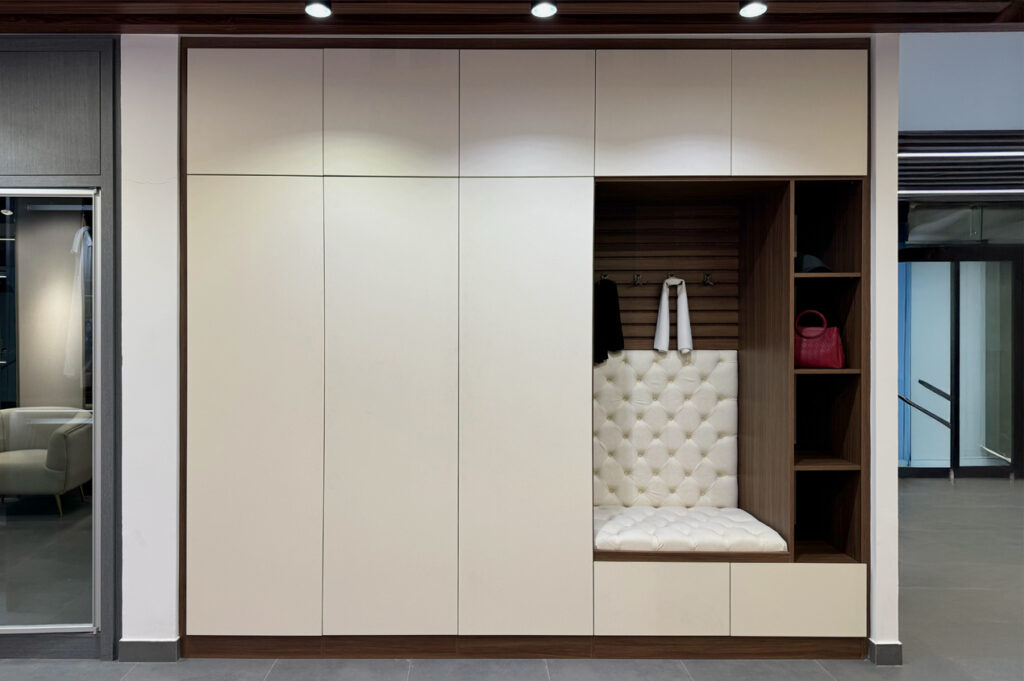
Why Low Ceilings Are a Storage Problem in the UAE
Understanding the scope of this challenge requires looking at the UAE’s residential building landscape and how ceiling height directly impacts wardrobe function and room perception.
The Reality of UAE Ceiling Heights
Not every home in the Emirates features the soaring double-height lobbies seen in luxury villa brochures. In fact, a significant portion of the residential stock sits within a tight vertical range.
Older Dubai Apartments (Pre-2010)
Buildings constructed in Deira, Bur Dubai, Al Karama, and parts of Jumeirah during the early development boom commonly feature ceilings between 2.4 and 2.6 meters. These apartments were built for density, and every centimeter of vertical space was calculated to maximize the number of floors within permitted building heights.
Standard Mid-Range Apartments (2010-2020)
Properties across Dubai Silicon Oasis, International City, Al Nahda, and Sharjah’s residential corridors typically offer 2.6 to 2.7 meters of ceiling height. While slightly more generous, this range still creates problems for off-the-shelf wardrobes that are either too short (leaving dust-collecting gaps) or impossible to fit at standard retail heights.
Converted and Partitioned Spaces
Studio apartments with mezzanine levels, loft-style conversions, and rooms with dropped ceilings for ducted air conditioning can push usable ceiling height down to 2.3 meters or even lower, making storage design particularly demanding.
How Low Ceilings Affect Daily Storage
The impact goes beyond aesthetics. Low ceilings with poorly chosen wardrobes create cascading problems.
Dead Space Above Furniture
A standard freestanding wardrobe at 2.0 meters under a 2.5-meter ceiling leaves a 50-centimeter gap. That gap collects dust, looks unfinished, and wastes storage volume equivalent to an entire shelf layer across the wardrobe width.
Visual Compression
Wardrobes that stop well short of the ceiling make the room appear shorter than it actually is. The visible ceiling line above the furniture draws the eye to the limited height, amplifying the sense of confinement.
Reduced Hanging Capacity
With less vertical room to work with, poorly designed wardrobes sacrifice either long-hang space (for dresses and coats) or double-hang space (for shirts and folded trousers), forcing homeowners into uncomfortable compromises.
Door Clearance Issues
Hinged wardrobe doors in low-ceiling rooms with standard-height units may collide with ceiling fans, light fixtures, or crown molding. Even when clearance exists, the visual gap between door top and ceiling breaks the room’s design continuity.
Design Solutions for Low Ceiling Wardrobes
Addressing limited ceiling height requires more than simply ordering shorter furniture. It demands a design philosophy that turns the constraint into an advantage through precision engineering and visual strategy.
Floor-to-Ceiling Custom Fit
The single most impactful solution for low-ceiling rooms is a wardrobe built to the exact height of the ceiling, eliminating every millimeter of wasted space.
Precision Measurement
Our team measures ceiling height at multiple points along the wardrobe wall because ceilings in older UAE buildings are rarely perfectly level. Variance of 5 to 15 millimeters across a 3-meter span is common, and our process accounts for this through individually scribed top panels that follow the ceiling contour.
Integrated Crown Illusion
Rather than adding traditional crown molding (which consumes precious centimeters), our designers create a flush crown detail using a thin shadow line or chamfered edge where the wardrobe meets the ceiling. This produces a clean, integrated appearance that makes the wardrobe look like part of the architecture rather than a piece of furniture placed against a wall.
Top Storage Optimization
The upper section of a floor-to-ceiling wardrobe in a 2.5-meter room becomes dedicated seasonal storage. Suitcases, out-of-season clothing, spare bedding, and infrequently accessed items sit behind either lift-up flaps or small upper doors that match the main wardrobe facade.
Construction Approach
Custom panels are manufactured to precise dimensions at our facility and delivered in sections that can be assembled in the room without requiring the wardrobe to be tilted upright, which would be impossible in a space with limited overhead clearance. This flat-pack precision assembly method is essential for rooms where the ceiling height barely exceeds the wardrobe height.
Sliding Door Systems for Low Spaces
Door selection dramatically affects both function and perception in low-ceiling rooms. ClosetWorld’s product range includes door systems specifically engineered for height-constrained installations.
Why Sliding Doors Win in Low Rooms
Hinged doors require swing clearance and create a visual break at the top hinge point. Sliding doors, by contrast, glide along a track that sits flush against the ceiling, reinforcing the floor-to-ceiling visual line without any swing arc.
Top-Hung vs. Bottom-Rolling
For low-ceiling applications, top-hung sliding systems are preferred. The track mounts directly beneath the ceiling, and the door panels hang from concealed rollers. This eliminates the floor track (which reduces usable floor area and collects dust) and places the mechanical components where they are least visible.
Full-Height Panel Design
Sliding door panels that run the complete height of the wardrobe, from floor track to ceiling track, create an unbroken vertical line that visually stretches the perceived room height. Our design team avoids mid-height horizontal divisions on the door faces for exactly this reason.
Mirror Sliding Doors
Mirrored sliding panels serve double duty in low-ceiling rooms. They reflect the floor plane, creating a depth illusion that counteracts the visual compression of a low ceiling, while eliminating the need for a separate standing mirror that would consume limited floor space.
Horizontal Layout and Internal Division
Inside the wardrobe, the internal configuration must prioritize horizontal organization to make the most of the available vertical range.
Optimized Shelf Spacing
In a floor-to-ceiling wardrobe with 2.5 meters of internal height (minus structural thickness), shelf spacing follows a specific hierarchy. The lowest shelf sits at 40 centimeters for shoe storage or heavy items. Intermediate shelves at 30-centimeter intervals accommodate folded clothing. The upper zone uses 35 to 40-centimeter spacing for bulkier seasonal items.
Double-Hang Configuration
With limited ceiling height, double-hang sections become even more valuable. A 2.4-meter internal height accommodates two hanging rails at 110 centimeters apart (lower rail at 90 centimeters from the floor, upper rail at 200 centimeters), with a 40-centimeter shelf zone above the upper rail for folded items or storage boxes.
Pull-Down Rails
For wardrobes where the upper hanging rail would otherwise be unreachable, pull-down rail mechanisms bring clothing down to a comfortable access height. These are particularly effective in walk-in closet configurations within low-ceiling rooms where reaching overhead is impractical.
Drawer Stacking
Deep drawer units positioned in the lower third of the wardrobe maximize the zone that is most easily accessible in a low-ceiling configuration. Rather than a single tall column of shallow drawers, wider drawer stacks across the wardrobe base provide generous storage for accessories, undergarments, and folded casual wear.
Material Choices for Low Ceiling Installations
Material selection influences both the visual perception of height and the practical performance of wardrobes in the UAE’s climate. Our team of our design team helps clients navigate these decisions during free consultations.
Light-Toned Finishes
High-Gloss Laminates
Reflective surfaces bounce light upward, reducing the visual weight of the wardrobe and making the ceiling appear higher. Pale gray, cream, and soft white high-gloss finishes are the most effective options for low-ceiling rooms.
Light Wood Grains
For homeowners who prefer a natural aesthetic, light oak, ash, and maple-effect laminates maintain warmth while avoiding the visual heaviness of walnut, mahogany, or dark stained finishes that would make a low-ceiling room feel like a box.
Grade-A MDF Core
All ClosetWorld wardrobes use Grade-A MDF with a 15-year warranty as the structural core. In low-ceiling installations where the wardrobe spans the full wall and bears additional load from floor-to-ceiling integration, this material grade ensures long-term dimensional stability even in Dubai’s humidity conditions.
Handle-Free Designs
Push-to-open mechanisms and integrated grip profiles eliminate protruding handles that create visual noise on a wardrobe facade. In a low-ceiling room, a clean, unbroken surface from floor to ceiling reads as architectural paneling rather than furniture, which is exactly the perception that maximizes the sense of space.
Reach-in closet configurations with handle-free push-latch doors are particularly effective in bedrooms where the wardrobe occupies the primary wall and dominates the room’s visual character.
Humidity Considerations
Low-ceiling rooms in the UAE face specific climate challenges. The reduced air volume means less circulation, and the proximity of the wardrobe top to the ceiling can create a microclimate where condensation occurs if the AC system is not properly balanced.
Moisture-Resistant Backing
Our wardrobes use moisture-resistant MDF backing panels rather than standard hardboard. This is critical in floor-to-ceiling installations where the back panel is sealed against the wall with no ventilation gap.
Ventilated Internal Components
Perforated shelf supports and ventilation slots in the wardrobe’s internal partitions promote air movement throughout the closed unit, preventing musty odors and protecting garments from humidity damage.
Lighting Solutions for Low Ceiling Wardrobes
Proper lighting transforms a low-ceiling wardrobe from a dark storage box into a visually elevated feature that enhances the entire room.
Integrated LED Systems
Under-Shelf LED Strips
Warm-white LED strips mounted beneath each shelf illuminate the contents below while creating vertical layers of light that draw the eye upward through the wardrobe’s internal sections.
Vertical Edge Lighting
LED channels installed along the vertical edges of the wardrobe interior create the illusion of greater height by establishing strong vertical light lines that extend from floor to ceiling.
Automatic Activation
Door-triggered or motion-sensor LED systems ensure the wardrobe interior is fully illuminated the moment it is accessed. In a low-ceiling room, this instant brightness prevents the stooping and searching that occurs in under-lit spaces and makes the wardrobe feel more generous than its dimensions suggest.
Avoiding Overhead Fixtures
Standard wardrobe-top lighting is impractical in floor-to-ceiling installations. Instead, our designers integrate all lighting within the wardrobe structure itself, eliminating the need for fixtures that would require ceiling clearance that does not exist.
For dressing room and full bedroom configurations, we extend the lighting scheme to include ambient room lighting that complements the wardrobe’s internal illumination, creating a cohesive visual experience.
The Vertical Maximization Process
ClosetWorld’s approach to low-ceiling wardrobe projects follows a precision methodology we call Vertical Maximization, developed through thousands of installations in UAE apartments where every centimeter counts. Having worked with luxury villas, apartments, and commercial properties, our team has refined this process across 3,000+ completed installations.
Ceiling Height Measurement
The process begins with a detailed site survey where our technician measures ceiling height at no fewer than six points along the proposed wardrobe wall. Laser measurement tools capture readings accurate to 1 millimeter, identifying any slope, sag, or irregularity in the ceiling plane. In older Dubai buildings, we frequently discover height variations of 10 to 20 millimeters that would cause visible gaps if not accounted for in the manufacturing specifications.
Clearance Calculation
With the raw ceiling measurements in hand, our design team calculates the precise clearance required for installation. This includes the space needed to stand the wardrobe carcass upright (or assemble it in place for the tightest ceiling scenarios), the tolerance for the ceiling-contact panel, and the operational clearance for sliding door tracks or hinge mechanisms. The goal is a finished clearance of no more than 3 millimeters, invisible to the eye and sealed with a matching filler strip.
Custom Panel Sizing
Every panel, shelf, and partition is manufactured to the exact dimensions derived from the site survey, not from standard modular sizes. Our factory cuts panels to individual measurements, meaning the left side of a wardrobe may be 2 millimeters taller than the right side to follow the ceiling’s natural contour. This bespoke approach is what distinguishes a custom low-ceiling wardrobe from an adapted flat-pack unit.
Optimal Shelf Spacing
With the total internal height established, our designers calculate shelf positions using ergonomic principles adapted for the specific ceiling height. Rather than applying standard spacing from a catalogue, each shelf position is determined by the items it will hold, the user’s height, and the remaining vertical space after hanging zones are allocated. This ensures no shelf is wasted and no zone is uncomfortably tight.
Integrated Crown Molding Illusion
The final step addresses the junction between wardrobe and ceiling. Rather than leaving a raw edge or adding chunky molding that would consume space, our installation team fits a precision-machined shadow gap profile. This thin reveal line (typically 8 to 12 millimeters) creates the architectural illusion of the wardrobe being recessed into the ceiling, as though the entire structure was part of the original building. The result is indistinguishable from bespoke joinery costing significantly more.
Real Project: Al Karama Apartment Transformation
Client: Nadia R., 2-bedroom apartment in Al Karama, Dubai
Challenge: 2.45-meter ceilings throughout, with existing freestanding wardrobes leaving 45-centimeter dust-collecting gaps and making the already compact bedrooms feel smaller
Solution: Floor-to-ceiling sliding-door wardrobes in both bedrooms with integrated LED lighting, pull-down upper rails, and high-gloss cream finish
Result: 35% increase in usable storage capacity, elimination of dead space above wardrobes, and both rooms visually appearing taller despite no structural changes
Timeline: Design to completion in 8 business days
“I had lived with those gaps above my wardrobes for six years and just accepted that was how apartments look. The ClosetWorld team showed me that custom-fit wardrobes could make my ceilings look higher, not lower. The difference is remarkable.”
— Nadia R., Al Karama
Visual Tricks to Add Height Perception
Beyond the wardrobe itself, our design team advises on complementary strategies that enhance the sense of vertical space throughout the room.
Vertical Line Emphasis
Full-Height Door Panels
Wardrobe doors that run unbroken from floor to ceiling establish the strongest possible vertical line. Any horizontal break, whether a visible rail, a mid-height join, or a contrasting panel, shortens the perceived height.
Vertical Groove Detailing
Subtle vertical grooves routed into wardrobe door panels create a gentle rhythm of shadow lines that the eye follows upward, reinforcing height perception without adding visual complexity.
Matching Wall and Wardrobe Tones
When the wardrobe finish matches the adjacent wall color, the boundary between wall and furniture disappears. The room reads as one continuous surface from corner to corner and floor to ceiling, maximizing the perception of space.
Strategic Mirror Placement
Mirrored wardrobe doors reflect the opposite wall, doubling the visual depth of the room and reducing the sense of enclosure that low ceilings create. For kids’ rooms where full mirrors may not be appropriate, partial mirror panels or frosted mirror finishes achieve a similar effect with added safety.
Minimalist Hardware
Every visible hardware element, including handles, hinges, and pulls, creates a horizontal reference point that interrupts the vertical flow. In low-ceiling rooms, handle-free designs using push-open mechanisms or J-pull profiles integrated into the door edge maintain clean vertical surfaces.
Door System Selection Guide
Choosing the right door system is one of the most consequential decisions for a low-ceiling wardrobe. Each option carries specific advantages and trade-offs.
Sliding Doors
Best for: Rooms under 2.5 meters where swing clearance is tight
Advantages: No swing arc, flush ceiling track, full-height visual line
Considerations: Requires space for panels to stack when open, limiting simultaneous access to the full wardrobe width
ClosetWorld recommendation: Preferred choice for low-ceiling bedrooms and entertainment areas
Hinged Doors with Concealed Hinges
Best for: Rooms between 2.6 and 2.7 meters where ceiling clearance allows proper swing
Advantages: Full opening width, conventional operation
Considerations: Door top may need clearance notch for ceiling fixtures, visible gap at hinge line
ClosetWorld recommendation: Suitable when swing clearance is confirmed during site survey
Bi-Fold Doors
Best for: Narrow rooms where sliding panel stacking would block access
Advantages: Full opening width with reduced swing arc
Considerations: Folding mechanism adds complexity, and the top pivot point must be precisely aligned with the ceiling track
ClosetWorld recommendation: Ideal for corridor-style wardrobes and laundry room installations where space is constrained in both height and depth
Open Wardrobe Systems
Best for: Rooms where door clearance is impossible or where a contemporary aesthetic is desired
Advantages: No door mechanisms to accommodate, full visibility of contents
Considerations: Contents must be organized attractively, dust exposure requires more frequent maintenance
ClosetWorld recommendation: Effective in vanity areas and auxiliary storage zones
Showroom Experience: See Low-Ceiling Solutions in Person
Both ClosetWorld showrooms feature dedicated low-ceiling display sections where visitors can experience the design principles described in this guide as installed, functioning wardrobes.
Dubai Showroom
Located at Umm Suqeim St, next to Creative Minds, Al Barsha 2, our Dubai showroom displays a full-scale 2.5-meter ceiling wardrobe installation with sliding mirror doors, integrated LED lighting, and pull-down rail mechanisms. Visitors can operate the components, examine the ceiling junction detail, and compare material finishes side by side.
Hours: Sunday to Friday 09:30 to 21:00, Saturday 13:00 to 21:00
Sharjah Showroom
Our Sharjah location at Industrial Area 18, Maleha St, includes a low-ceiling demonstration zone alongside our complete product range. Design consultants are available during all operating hours to discuss specific apartment layouts and provide preliminary recommendations.
Hours: Sunday to Friday 09:30 to 21:00, Saturday 13:00 to 21:00
Schedule your complimentary design session by calling 800 29029 or visiting our contact page.
Start Your Low-Ceiling Wardrobe Project
Living with low ceilings does not mean living with compromised storage. Whether you are in an older Al Karama apartment with 2.4-meter ceilings or a mid-rise Sharjah residence at 2.6 meters, ClosetWorld’s Vertical Maximization approach transforms your ceiling height constraint into a design advantage.
Get your personalized storage assessment. Our team has completed 3,000+ installations across the UAE, and our certified design consultants specialize in ceiling-height-constrained spaces. Call 800 29029 today, visit our showrooms in Dubai or Sharjah, or explore our full range of custom wardrobe products to see how precision design solves the low-ceiling challenge.
Trusted by 3,200+ families across the Emirates, ClosetWorld delivers premium craftsmanship and attention to detail in every installation. Learn more about our story and discover why homeowners across the UAE choose ClosetWorld for storage solutions that are built to fit, not forced to fit.
Written by Ahmad Hassan, Senior Design Consultant (15+ years experience)
ClosetWorld — 14+ years, 14 years of excellence in custom storage solutions