
Corner Wardrobe Solutions in the UAE: Making the Most of an Awkward Corner
A standard wardrobe run is 60 cm deep — so wherever two runs meet at 90°, a 60 × 60 cm blind pocket forms behind them, and under the 2.6 m minimum ceiling height Dubai’s building regulations require for habitable rooms, that pocket is roughly 0.9 m³ of storage a straight unit simply seals off. Corner wardrobe solutions recover that lost volume with mechanisms built around the angle itself: an L-shaped unit with diagonal hanging, a rotating carousel, or a pull-out corner system. ClosetWorld engineers corner wardrobes around the geometry, not around a standard module forced to fit.
This is a different problem from a narrow room or a low ceiling. A narrow-space wardrobe is about width, a low-ceiling solution is about height, and under-stairs storage is about slope — but a corner is about angle, and angles need their own mechanisms.
Updated for 2026.
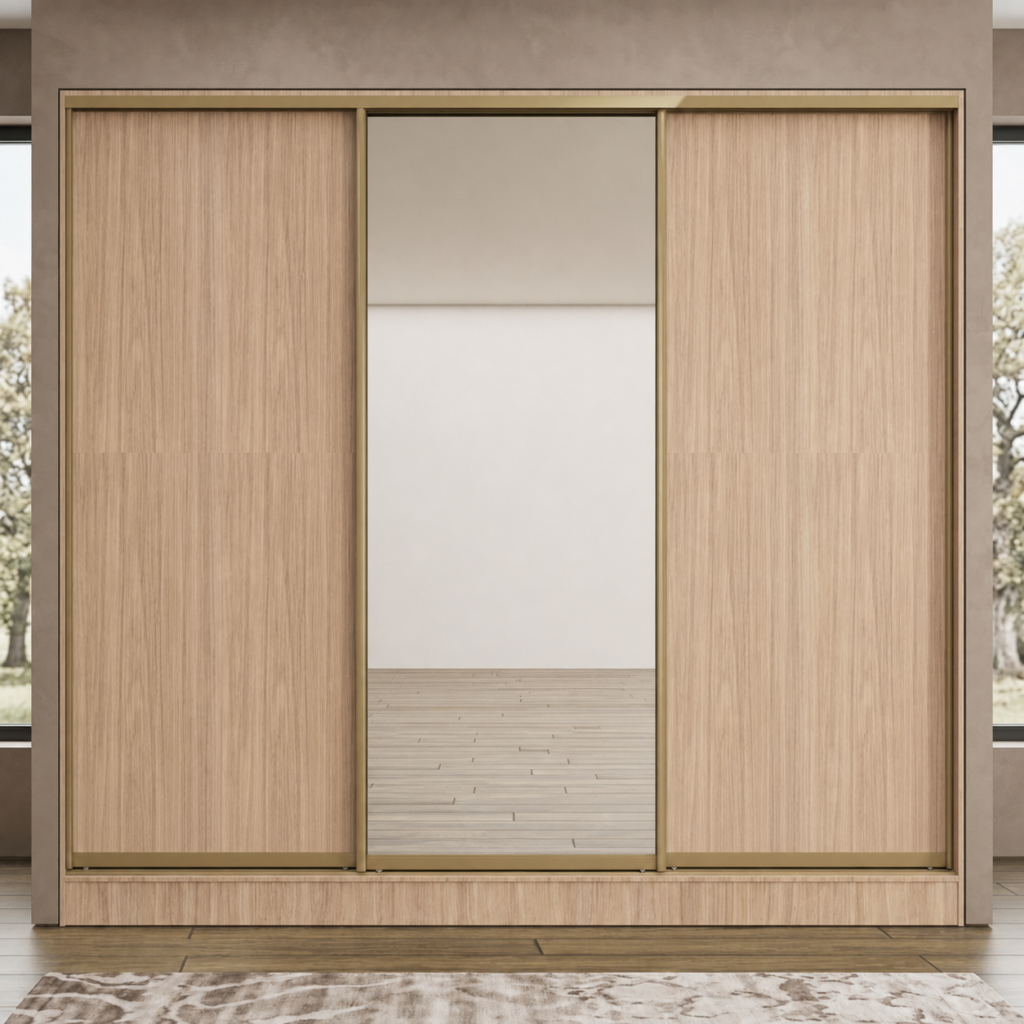
Why corners get wasted
When two wardrobe runs meet at a right angle, the inner corner becomes a deep, dark pocket. With a standard straight wardrobe pushed into the corner, that pocket is either sealed off entirely or accessible only by reaching blindly past hanging clothes. The result is wasted cubic metres in exactly the part of the room that’s hardest to use any other way.
There are three ways to recover it, and the best choice depends on what you store and how the room is laid out:
Access the corner directly with a unit and door designed to open into it.
Bring the corner to you with rotating or pull-out mechanisms.
Hang across it with a diagonal rail that turns the corner into prime hanging space.
Comparing corner wardrobe solutions
Each approach trades accessibility, capacity, and complexity differently. This is the comparison we walk clients through:
| Corner solution | Accessibility | Capacity | Complexity | Best for |
|---|---|---|---|---|
| L-shaped unit with diagonal corner door | Good | High | Medium | Most bedrooms — the all-rounder |
| Diagonal hanging rail across the corner | Excellent for hanging | High (hanging) | Low–medium | Long-garment storage, abayas, coats |
| Corner carousel / rotating shelves | Excellent | Medium | High | Reaching deep shelves without bending in |
| Pull-out corner mechanism (magic corner) | Excellent | Medium | High | Accessories, shoes, folded items |
| Bi-fold / pivot corner doors | Good | High | Medium | Wide openings into a deep corner |
| Open angled corner shelving | Excellent (visible) | Low–medium | Low | Display, books, decorative items |
| Blank corner with side access | Limited | High (deep store) | Low | Rarely-used seasonal storage |
In practice, most bedrooms we design use an L-shaped unit with a diagonal corner door as the backbone, often combined with a diagonal hanging rail so the deepest part of the corner holds full-length garments — the same long-garment thinking behind our abaya and kandura storage.
Decision factors
Choosing between these comes down to a few questions we work through with you:
What goes in the corner? Hanging clothes suit a diagonal rail; folded items and accessories suit a carousel or pull-out; rarely-used items can go in a deep blank corner.
How deep is the corner? Deeper corners justify carousels and pull-outs; shallower ones work better with diagonal hanging.
Door clearance. Bi-fold and pivot doors need less swing space than a wide hinged door — important in a tight bedroom.
Budget and mechanism. Carousels and magic-corner pull-outs add cost and complexity; a well-designed L-unit with diagonal hanging delivers most of the benefit more simply.
Because the answer is rarely one mechanism, we usually combine two or three — and getting deep corners properly lit with integrated LED is what makes the recovered space genuinely usable rather than a dark hole.
How to plan a corner wardrobe
A corner wardrobe rewards planning before construction. These are the steps we follow on every corner project:
Measure both walls and the corner depth. Record the full length of each run and how deep the returning corner is — this determines whether a carousel even fits.
Map the door swings and obstacles. Note the room door, windows, radiators or AC units, and any skirting, so doors and pull-outs clear everything.
List what the corner must hold. Separate hanging from folded from accessories — the contents dictate the mechanism.
Choose the corner mechanism. Match the solution to the contents and depth using the comparison above.
Plan access and light. Add LED lighting and ensure the chosen mechanism brings the back of the corner within easy reach.
Visualise in 3D before building. Confirm clearances and capacity virtually so there are no surprises on installation day.
This is the same disciplined, made-to-measure approach we bring to a full walk-in closet — the corner is simply its most technical junction.
What to store in a recovered corner
A corner solved well becomes prime real estate, not an afterthought. We typically use it for:
Long hanging garments on a diagonal rail — dresses, coats, and traditional dress that need an uninterrupted drop.
Accessories on a pull-out — bags, folded knits, or shoes brought forward at a touch.
Seasonal and rarely-used items in the very deepest blank section, where access matters least.
For an L-return wardrobe in a master bedroom, the corner often becomes the hanging hub of the whole unit, while a compact bedroom benefits from a corner reach-in closet that wraps storage around two walls without dominating the floor.
A representative project
Here’s an example assembled from the corner-wardrobe briefs UAE homeowners regularly bring us — a blend of common situations, not an account of one named client:
Project: Jumeirah Village Circle apartment, Dubai. An L-shaped bedroom had two short walls with a dead corner between them, and the owner’s previous flat-pack wardrobe simply sealed the corner off. We designed an L-shaped unit with a diagonal corner door, a diagonal hanging rail through the deepest point for long dresses, and a pull-out shelf system for accessories on the shorter return. The recovered corner added roughly a third more usable storage to the same footprint.
Corners beyond the bedroom
The same corner logic applies wherever two walls meet, and recovering those corners adds storage right across the home:
Walk-in closets across Dubai’s apartments, villas, and high-rises almost always have a corner where two runs of hanging meet — a diagonal rail or carousel there prevents the most common walk-in dead spot.
Home offices and studies benefit from L-shaped corner cabinetry that wraps a desk and shelving efficiently into a compact footprint.
Living and dining corners can take an angled display or media unit rather than leaving the corner empty.
Wherever the corner sits, the principle holds: an angle is an opportunity, not a problem, once the storage is designed around it rather than forced past it. We treat each corner as a deliberate junction in the overall plan, which is what keeps a custom fit-out feeling seamless from wall to wall instead of a row of boxes with gaps between them.
How we design a corner wardrobe
We start with precise measurements of both walls and the corner depth, map every door swing and obstacle, and establish what the corner needs to hold. From there we match the mechanism — diagonal rail, carousel, pull-out, or a combination — and visualise the whole unit in 3D before building, so clearances and capacity are confirmed in advance.
You can follow that consultation-to-installation process on our process page; configurations live on our products page and within our broader small-space storage approach. After 3,000+ completed fit-outs and a UAE production line operating over 14 years, our designers have turned countless dead corners into the hardest-working storage in the room.
Got an awkward corner to solve? Request a free home visit, call 800 29029, or visit our Sharjah or Dubai showrooms to see corner mechanisms in action. Get your personalized storage assessment and reclaim yours.
Frequently asked questions
How do you stop a corner wardrobe from wasting the corner?
What is a corner carousel and when is it worth it?
Can a corner wardrobe hold full-length clothes like abayas and coats?
Is an L-shaped wardrobe good for a small bedroom?
Do corner wardrobe doors need a lot of clearance?
What's the difference between a corner wardrobe and a narrow or low-ceiling one?
How much extra storage does solving the corner add?
What affects the cost of a corner wardrobe in the UAE?
Related Reading at ClosetWorld
Solutions for genuinely narrow rooms (a width problem, not an angle) — the sibling constraint, handled differently
Full-height design for low ceilings (a height problem) — reclaiming vertical rather than angled space
Reclaiming the slope under a staircase — another awkward-volume specialism
The wider small-space storage strategy — the pillar this corner guide sits under
Long-garment hanging that suits a diagonal corner rail — what often fills the recovered corner
L-return wardrobes built into the master bedroom — where corner units do their best work
Compact reach-in configurations that wrap two walls — the product behind a corner bedroom wardrobe
Author bio: with 15+ years as a Senior Design Consultant, Ahmad Hassan leads ClosetWorld’s made-to-measure projects in the Emirates and Oman. Revised for 2026. Want that awkward corner back? Claim your free design consultation, see our story at ClosetWorld, or call us on 800 29029.